

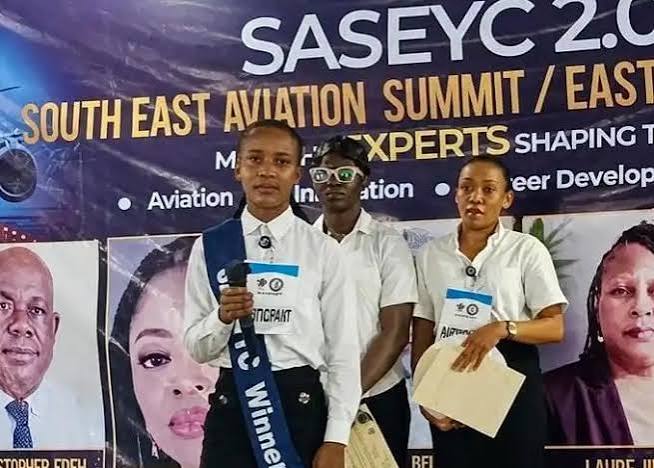
Ask most Nigerian students what a career in aviation looks like and the answer is usually “pilot.” A summit held in Enugu on October 3, 2026 set out to widen that picture. The second edition of the South East Aviation Summit Eastwing Youth Competition, known as SASEYC 2.0, brought together more than 50 young people, including secondary school students and aviation enthusiasts, at Bon Platinum Hotel. The theme was “Advancing Youth Potentials Through Aviation Innovation and Excellence.”
Why exposure has to start early
Dr Christopher Edeh, founder and CEO of Eastwing Aviation Institute, said the programme exists because earlier generations never got a chance to see the industry up close. Drawing on his own years in the Nigerian Air Force, he argued that students should meet aviation early enough to make informed choices, whether that means flying, aircraft engineering or another specialised field.
He also made the case that aspiring professionals should not have to leave the country to get quality training. That is why he stressed accredited options at home, and he pointed to Eastwing’s partnerships with aviation institutions in Scotland and with the Nigerian College of Aviation Technology (NCAT) as a way of bringing industry relevant training closer to the South East.
Edeh also looked back at why several Nigerian airlines have collapsed over the years. In his view, an airline stays afloat when it pays workers on time, strictly replaces aircraft parts that have a limited life, keeps retraining its pilots and engineers, and manages fuel and other resources carefully. He praised the Nigerian Civil Aviation Authority (NCAA) for enforcing safety standards across the industry.
More jobs than most people realise
The Father of the Day, His Royal Highness Igwe Dr Lawrence Agubuzu, urged young people to get past any fear of flying, noting that air travel is statistically among the safest ways to travel. He also listed career paths that have nothing to do with the cockpit:
Aircraft maintenance engineering
Cabin crew services
Aviation and operations management
Safety oversight
Air traffic services
Ticketing and passenger support
Aviation security
Administrative management
His advice was to pursue specialised training and collect the certificates and professional qualifications that make steady employment possible.
The skills gap behind the opportunity
Dr Ibrahim Bello Bashir, Rector of Federal Polytechnic Damaturu in Yobe State, cited a Boeing projection that the global industry will need about 2.5 million personnel in the coming years, from pilots and engineers to cabin crew and ground staff. He sees Nigeria’s youthful population as an advantage, but only if young people are trained. He added that skills shortages have left some roles filled by foreign nationals when qualified Nigerians could do the job.
Laure Jifack, founding partner of Aeropath and CEO of Ubuntu HR Consulting, focused on aircraft maintenance. She said Africa will need roughly 24,000 new maintenance technicians by 2044, while training capacity across the region falls well short of that. Safe flying, she pointed out, depends heavily on engineers and certified technicians.
In her view, talent is not the problem. Access is. Training is expensive, often requires travel, and takes a long time, which keeps many capable young Africans out. She said Eastwing and Aeropath could work together to spot talent early and connect students to internationally recognised certification, including EASA Part 66, a European licence standard for aircraft maintenance engineers.
A winner’s tears and a first edition success story
The most emotional moment came when certificates were handed to the top 10 competitors. The overall winner, Felix Favour Chinecherem, broke down in tears when her name was called. She said she has wanted a career in aviation since she was 10 years old, and she urged other young people not to give up on their dreams because of difficulties.
The summit’s convener, Christian Agadibe, CEO of Artmatazz Media, said the first edition’s winner, Uyamadu Franklin, has since moved to Abuja, where he is doing his industrial training in aircraft maintenance. For Agadibe, that shows what can happen when young people get exposure, guidance and opportunity at the right time.











Comments (0)
No comments yet — be the first.